What's Happening at Yandex's Data Centers: Status Update as of October 13, 2026, and What It Means for Users and Businesses
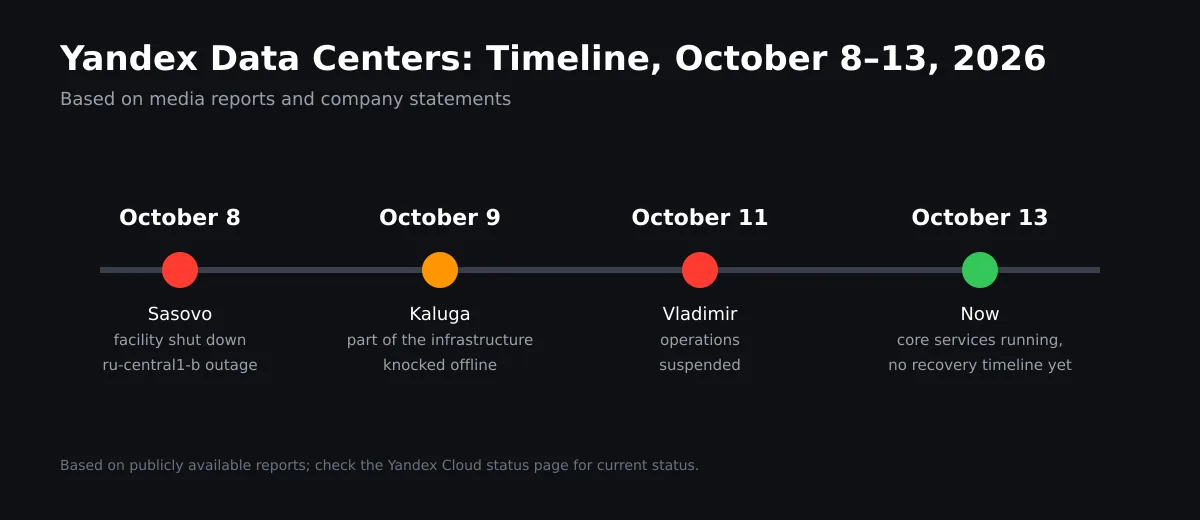
Timeline of Events
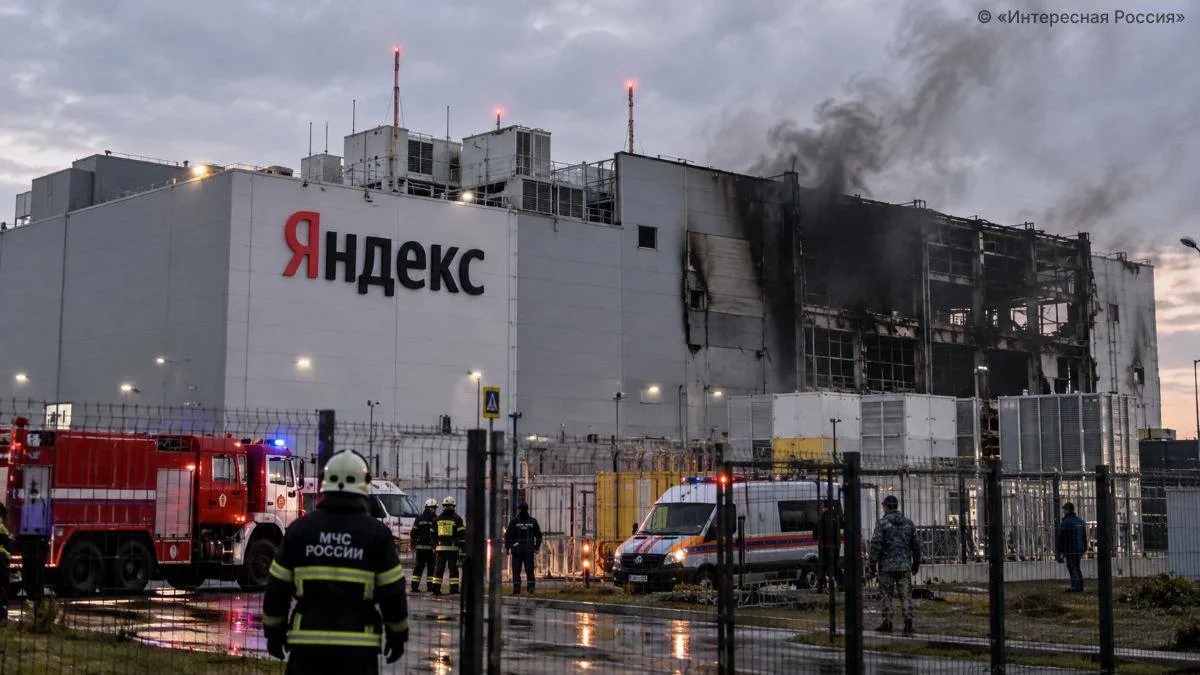
The past week has been the toughest in the history of Yandex's infrastructure. According to media reports, three of the company's data centers - in Sasovo, Kaluga, and Vladimir — were hit by drone attacks between October 8 and October 11. Several facilities have been shut down, one of the availability zones in the Yandex Cloud platform was affected, and users experienced disruptions to the Alice voice assistant, AI-powered features, and smart home devices.
This article offers a calm, fact-based overview: what we know as of October 13, how Yandex's infrastructure is built and why some services kept running while others didn't, and what everyday users and businesses running on Yandex Cloud should do now. One important caveat: the situation is still developing, and some of the information comes from media sources rather than official statements. For recovery timelines, check the official Yandex Cloud status page and company announcements.
Timeline of Events
October 8 - Sasovo (Ryazan Region). According to reports, the data center in Sasovo was attacked overnight on October 8. The facility has operated since 2014 on the grounds of the former Sasta machine-tool plant. Operations were fully suspended, and a fire damaged part of the infrastructure. The company said no one was injured.
October 8 - Yandex Cloud. The same day, the company reported power supply issues in the ru-central1-b availability zone and advised customers to move their workloads to other zones where possible. Creation of new virtual machines, Kubernetes clusters, and databases in the remaining zones was also temporarily restricted — most likely to free up capacity for the mass migration.
October 9 - Kaluga. The Kaluga data center, the company's largest, was reportedly attacked, and part of its infrastructure went offline. According to media reports, Kaluga houses the Chervonenkis and Lyapunov supercomputers, which are used to train AI models.
October 11 - Vladimir. According to a source, drones struck the data center on the outskirts of Vladimir, after which the company suspended operations at the site.
October 13. As of publication, there is no official confirmation that the affected facilities have been fully restored. The company says its core consumer services remain up and running.
How Yandex's Infrastructure Works
To understand why the incidents hit some services hard and barely touched others, it helps to look at how the system is built.
Multiple sites, not one. For years, Yandex has built its own data centers across different regions - Vladimir, Sasovo, Kaluga, and facilities in the Moscow Region. The whole point is that losing a single site shouldn't take down the entire company.
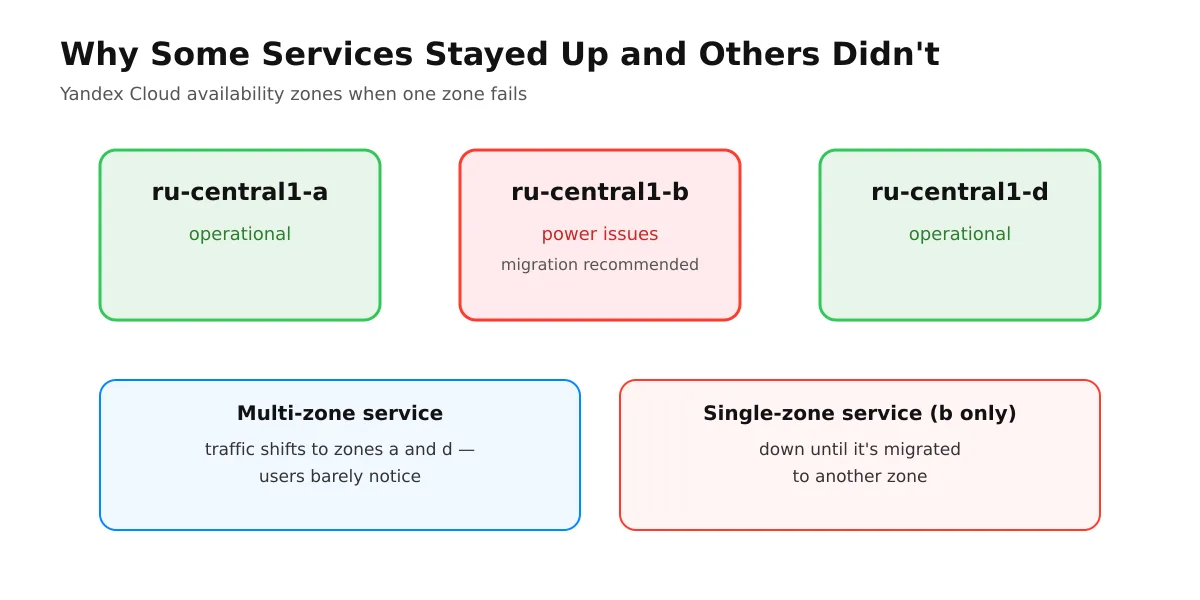
Availability zones in the cloud. The Yandex Cloud public platform is divided into availability zones: ru-central1-a, ru-central1-b, and ru-central1-d. Each zone is a separate site or group of sites with its own power and networking. If a customer deploys an application across multiple zones, an outage in one of them won't take the service down.
Redundancy for internal services. Search, Mail, Maps, and Yandex's other high-traffic services typically run across several data centers at once. When one site goes down, the load is redistributed to the others. Users may notice slowdowns, but not a complete outage.
Specialized hardware. Supercomputers used to train AI models work differently: they're massive GPU clusters concentrated in a single location. They can't simply be "moved" to another data center overnight. That's why AI features — and the voice assistant that depends on them — took a bigger hit than everything else.
What Everyday Users Noticed
According to the company and user reports, disruptions affected:
• the Alice voice assistant, including on smart speakers;
• AI-powered features across Yandex services;
• some smart home devices that are controlled through the cloud.
Meanwhile, Search, Mail, Maps, and other core services kept running, according to the company. It's a textbook example of redundancy at work: high-traffic services are spread across multiple sites, while compute-heavy AI systems depend more heavily on specific hardware.
What Everyday Users Should Do
If Alice isn't responding. Check that your speaker is connected to the internet and restart it. If the issue persists across all your devices, the problem is most likely on the server side — you'll just have to wait for it to be fixed.
If your smart home isn't working. Devices that rely entirely on the cloud may temporarily ignore commands. Many lights and smart plugs can still be switched on manually with a physical button. If independence from the cloud matters to you, look for local control support when buying new devices.
If you're worried about your data. As of publication, there have been no reports of user data loss in core services. Still, this is a good reminder about backups: keep important photos and documents in at least two places.
Watch out for scammers. High-profile news always brings a wave of fake emails and messages "from customer support" asking you to "verify your account" or "migrate your data." Yandex will never ask for your password or SMS codes. Only sign in through official apps and websites.
What Businesses on Yandex Cloud Should Do
For businesses, this week has been a serious stress test. The key lesson is simple: applications deployed across multiple availability zones kept running, while systems that lived in a single zone had to be moved in a hurry.
1. Check where your resources live. Anything running only in ru-central1-b is your first candidate for migration.
2. Migrate your virtual machines. According to the Yandex Cloud documentation, VMs in the ru-central1-a and ru-central1-b zones can be moved to ru-central1-d using a dedicated CLI command. Alternatively, you can take disk snapshots and spin up a copy of the VM in another zone. Take snapshots or backups before you start.
3. Migrate your managed services. It's best to rebuild database and Kubernetes clusters with nodes spread across multiple zones. According to the company, its support team is helping customers migrate managed services.
4. Plan around resource creation limits. In the first few days, creating new resources in the other zones was temporarily restricted. If you can't create a VM, contact support instead of retrying in a loop.
5. Rethink your architecture. Once the migration is done, tackle what's been put off for years: spread your application across at least two zones, set up a load balancer, make sure your backups are stored separately from your primary site, and run recovery drills.
6. Consider a second provider. According to reports, affected customers are being offered streamlined onboarding to Selectel, K2Cloud, and VK Cloud, along with flexible financial terms. For mission-critical systems, it makes sense to keep a backup with another cloud provider.
A Quick Checklist for CIOs
• Do we have any services running in a single availability zone?
• When did we last test a restore from backup?
• Are our backups stored in a different zone or with a different provider?
• How many hours of downtime can the business absorb without serious losses?
• Does the team have a step-by-step migration plan, not just a general idea of how to do it?
• Do our customers know where to check our service status during an outage?
If you can't confidently answer at least two of these questions, that's where to start once things settle down.
Why This Matters for the Entire Industry
This isn't just a Yandex story. Data centers are built to withstand fires, power outages, floods, and human error — but threats on this scale, where several of one company's facilities go down within a few days, are a new reality for the industry. According to media reports, the attacks have already prompted proposals to strengthen protection for critical digital infrastructure, and cloud providers are coordinating to help customers migrate.
For businesses, the takeaway is clear: geographic distribution and redundancy are no longer an "expensive option for the big players" — they're a baseline requirement. For users, it's a reason to value services that are transparent about outages, and to avoid keeping everything important in a single place.
What Comes Next
As of October 13, no official recovery timeline has been announced for the suspended facilities. Core consumer services will likely keep running on backup capacity, AI features will probably come back gradually, and cloud customers will continue shifting workloads between zones for some time. For the latest updates, follow the official Yandex Cloud status page and the company's official channels.
The Bottom Line
As of October 13, 2026, Yandex's infrastructure is operating in emergency mode: several facilities have been shut down, one cloud zone has been affected, and AI features and Alice are experiencing disruptions. Even so, core services remain online thanks to a distributed architecture. Users should be patient and stay alert for scams, while businesses should move workloads out of the affected zone — and finally make their systems truly fault-tolerant.
Sources: